Select Page

Month: July 2021

JACKIE MASON, R.I.P.

Catholic League president Bill Donohue comments on the death of Jackie Mason: We lost a true American icon on July 24 when Jackie Mason passed away at the age of 93. He was more than a remarkable comedian, he was a strong foe of anti-Catholicism. I wor…

Read More

Focus on the Duty of the Moment

At the end of our days, the Catholic Church teaches that every human person must reckon with the same realities. She calls these the “Four Last Things”: Death, Judgement, Heaven, and Hell. We all will die. We all will meet Christ the Judge. And we all will enter into the eternity which we freely chose through our actions in the world. 

Read More

Benedict XVI laments lack of faith within Church institutions in Germany

Pope Benedict XVI on Aug. 28, 2010. / L’Osservatore Romano.

Freiburg, Jul 26, 2021 / 06:30 am (CNA).

Pope emeritus Benedict XVI has expressed concern about the lack of faith within Church institutions in Germany.

The retired pope made the comments in a written conversation in the August issue of the German magazine Herder Korrespondenz, marking the 70th anniversary of his ordination to the priesthood, reported CNA Deutsch, CNA’s German-language news partner.

“In Church institutions — hospitals, schools, Caritas — many people participate in decisive positions who do not share the inner mission of the Church and thus in many cases obscure the witness of this institution,” he said.

In an exchange with Tobias Winstel, the 94-year-old reflected on the concept of the “Amtskirche,” a German term that can be translated as “institutional Church” and is used to refer to the large number of Church-tax funded structures and institutions in Germany.

He wrote: “The word ‘Amtskirche’ was coined to express the contrast between what is officially demanded and what is personally believed. The word ‘Amtskirche’ insinuates an inner contradiction between what the faith actually demands and signifies and its depersonalization.”

He suggested that many texts issued by the German Church were crafted by people for whom faith was largely institutional.

“In this sense, I must admit that for a large part of institutional Church texts in Germany, the word ‘Amtskirche’ does indeed apply,” he commented.

He continued: “As long as in institutional Church texts only the office, but not the heart and the spirit, speak, so long the exodus from the world of faith will continue.”

Benedict, who was prefect of Vatican Congregation for the Doctrine of the Faith before he was elected pope, said: “That’s why it seemed important to me then, as it does now, to take the person out of the cover of office and expect a real personal testimony of faith from the spokesmen of the Church.”

In the conversation, Benedict also discussed an issue that he had highlighted in 2011, during his final trip to Germany before his resignation as pope in 2013.

In an address in Freiburg, a university town in southwest Germany, he implicitly criticized aspects of the German Church, referring to a tendency to give “greater weight to organization and institutionalization” than to the Church’s “vocation to openness towards God.”

Benedict called in the speech for a “Church that is detached from worldliness,” using the German phrase “entweltlichte Kirche.”

The former pope told Herder Korrespondenz that he now felt that the term was inadequate.

“The word ‘Entweltlichung’ [‘detachment from worldliness’] indicates the negative part of the movement I am concerned with,” he wrote. “The positive is not sufficiently expressed by it.”

Rather, he said, it is about stepping out of the constraints of a particular time “into the freedom of faith.”

In the written exchange, Benedict also warned Catholics against the danger of seeking a “flight into pure doctrine.”

Benedict, who was the Vatican’s doctrinal chief from 1982 to 2005, said that attempting such a flight was “completely unrealistic.”

“A doctrine that would exist like a nature preserve separated from the daily world of faith and its needs would be at the same time an abandonment of faith itself,” he said.

In the conversation, Benedict was also asked whether he was a good pastor when he served at Precious Blood church in the Bogenhausen district of Munich after his ordination on June 29, 1951.

“Whether I have been a good priest and pastor, I dare not judge,” he replied, adding that he had tried “to live up to the demands of my ministry and ordination.”

Read More

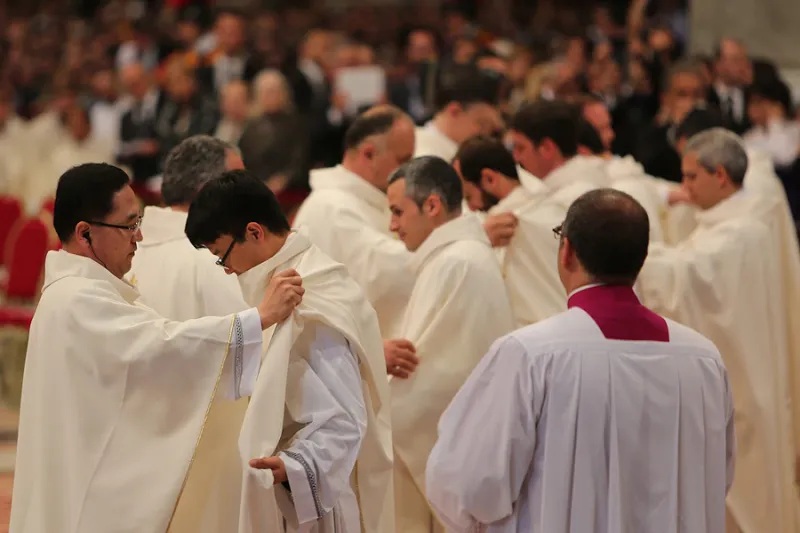
How priests prepare to say Mass

Newly ordained priests are vested during their Mass of Ordination in St. Peter’s Basilica, April 26, 2015. / Bohumil Petrik/CNA.

Washington D.C., Jul 26, 2021 / 06:01 am (CNA).

In preparation for Mass, priests make ready the sacred vessels, linens, and vestments that they use. Afterward, they take care to clean up. Every action they take, every word they say, stresses the importance of the Mass.

Two priests located in Washington, D.C., Fr. William Foley at the Shrine of the Most Blessed Sacrament and Fr. Charles Gallagher at Immaculate Conception, gave a behind-the-scenes look to EWTN News In Depth July 16.

Preparations for Mass are made in the sacristy.

“One of the first things I do is to make sure the chalice is ready,” Fr. Foley said. 

Priests often receive a chalice at their ordination. His family, he said, purchased his from a chalice maker in Montreal, Canada, over 42 years ago.

Both the chalice and the paten, a plate that holds the hosts, consist of precious metals.

“The reason why the paten is – and the chalice – are so beautiful,” Fr. Gallagher said, is “because they really touch God. And we want to give the best we have to God.”

Linens also play a critical role in the Mass. The corporal, which takes its name from the Latin word for “body,” is a square linen cloth that often has a cross embroidered on it. 


It exists, Fr. Foley said, so that “during the Mass, when the priest breaks the host, nothing falls off of it.” Instead, the cloth catches the body of Christ. 

Fr. Gallagher also discussed the purificator. 

“So after the chalice is used,” he said, “I consume the remaining precious blood and I rinse it with water and then I use the purificator to wipe it and to dry it.”

After the vessels and linens are prepared, the priest vests.

First, the priest “says a special prayer to wash his hands,” Fr. Gallagher said.

“This prayer in Latin says, ‘Give, Lord, strength to my hands to wipe out all stain so that, without pollution of mind or body, I may dare to serve You,’” he translated.

One layer at a time, the priest gets ready for Mass.

“The first is called an amice,” said Fr. Gallagher, pointing to a white cloth that wraps around the shoulders and neck. “This is really meant to be like a helmet of salvation.”

Then, “over the amice, I put on the alb,” he said. The floor-length white vestment with sleeves is put on with the prayer “Wash me clean, Lord, and cleanse me from my sin; that I may rejoice and be glad unendingly with them that have washed their robes in the blood of the Lamb.”

Around the alb, the priest places a cincture, the prayer for which is: “Gird me, Lord, with the belt of faith, my loins with the virtue of chastity, and extinguish in them the humour of lust; that the strength of all chastity may ever abide in me.”

Next comes the stole, at which the priest prays, “Restore to me, Lord, I beseech Thee, the stole of immortality, which I lost in the transgression of the first father; and, though unworthy I presume to approach Thy sacred mystery with this garment, grant that I may merit to rejoice in it forever.”

Finally, the priest dons the chasuble, a sleeveless and often ornate outer vestment, praying, “O Lord, who said: my yoke is sweet and my burden light: grant that I may be able so to bear it, so that I may be able to obtain Thy grace.”

The point of the prayers for the vestments “is that the priest is covering up his humanity, because it’s Our Lord Jesus who celebrates the Mass,” Fr. Gallagher emphasized. “So all of these different elements help the priest realize it’s Our Lord Jesus who is taking over.”

He added, “Yes, he uses my voice, my hands, my gestures, but it’s really Our Lord and his power that is able to change the bread into his body.”

Following the Mass, the linens and the vessels must be cleaned.

“It’s washed in a very special way,” Fr. Foley said, pointing to the corporal. “Because it may, it comes in contact with the precious host, the precious blood.”

Fr. Gallagher added, “It would soak for a few days in water along with any other – the sacred linens.” That water is later “poured into a special sink that we call a sacrarium.”

The sacrarium, Fr. Foley said, “goes not into the sewer system, but into the dirt, into the ground,” so that “the precious body and blood of the Lord does not get mingled with sewage.”

Their actions and words point to the reverence due to the Mass and the body and blood of Christ.

“The Mass is actually not one of the most time-consuming things we do, but it is the most important thing we do,” Fr. Gallagher concluded. “So that’s why it’s sort of shrouded with all these special rituals, prayers of preparation to help the priest prepare and celebrate Mass very well. And that’s the most important thing he can do for his people.”

Read More

Recent Comments

    Categories