Select Page

Month: June 2020

German bishop calls for Rome synod to discuss German synod

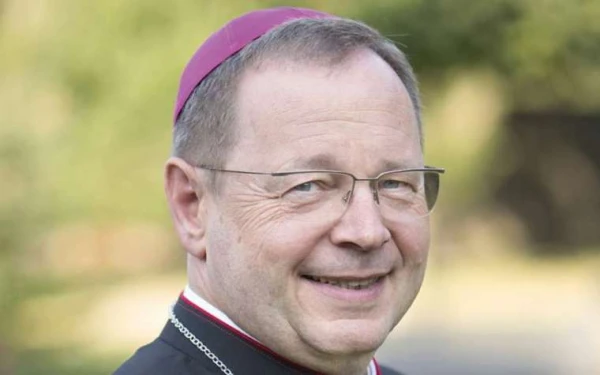
CNA Staff, Jun 3, 2020 / 01:31 pm (CNA).- The president of the German bishops’ conference has called for a synod in Rome that would discuss resolutions of the German “synodal process” at the level of the universal Church.

“What arises synodally must also be clarified and answered synodally,” Bishop Georg Bätzing of Limburg said, explaining he was “very much in favour of transporting to Rome, to the level of the whole Church, the insights and decisions that we garner from the Synodal Process – also with regard to [the role of] women and ecclesial ministry.”

In an interview with the magazine “Publik-Forum” published May 27, the bishop reiterated his support for the “Synodal Process” currently underway in Germany, and for resolutions providing for “coalitions that set changes.”

Bätzing, 59, who succeeded Cardinal Reinhard Marx as president of the German bishops’ conference in March, also said he had “concrete ideas about what can be achieved in the Forums” of the process.

Resolutions of the synod could include the introduction of a Church blessing for homosexual couples, according to Bätzing. The bishop said that “quite a few suffer from the fact that their relationship does not receive full Church recognition”, adding that those affected were waiting for a positive “signal” from the Church and warned that in his view, the magisterium of the Church, as currently proclaimed, was perceived by people as one of “prohibitive morals.”

Pope Francis has repeatedly emphasized that the Church’s teaching regarding the morality of homosexuality is a matter of doctrine that cannot change.

In 2003, the Vatican’s Congregation for the Doctrine of the Faith explained that “The Church teaches that respect for homosexual persons cannot lead in any way to approval of homosexual behavior or to legal recognition of homosexual unions.”

Despite those things, Bätzing said that in his view “time is running out for us,” and stressed an urgent need for “changes.”

Other changes could include, the bishop told the magazine, the admission of Christians of other denominations to the Eucharist purely on the basis of their decision of conscience.

“Christians can decide with good arguments and according to their own conscience to participate in the Eucharist or Last Supper of the respective other denomination,” Bätzing said, since there was “now so much agreement about what we believe and celebrate.”

In 2018, Pope Francis said that the matter of intercommunion could only be decided by local bishops, and then only with respect for the Church’s norms on the subject.

Bätzing, who has previously voiced his potential support for the ordination of women, conceded that several Popes, including Pope Francis, had emphatically declared that the question of the admission of women to the priesthood was a closed one. However, this could not mean “that the question of the ordination of women is not discussed further,” the German bishop said.

Given the debate over an ordination of women was not going away, Bätzing continued, he supported bringing insights and resolutions garnered on the “Synodal Path” also “to Rome. What arises synodally must also be clarified and answered synodally.”

The German bishops’ conference president also said that in his view, a “lack of priests does not necessarily damage the vitality of the Church”, telling interviewers that he hoped for changes to “certain formulations as they reflect the current state of doctrine in the Catechism” of the Catholic Church.

Whilst the “substance of the Faith” is immutable, Bätzing asserted that in his view, “the self-revelation of God continues steadily.” Furthermore, the Church needs to always seek out the “signs of the times”, and where necessary “develop” its teachings, including those on sexual morality, as CNA Deutsch, CNA’s German-language news partner, reported.

Catholic teaching on the development of doctrine is complex. But the Church teaches that doctrine cannot develop in such a way that it contradicts itself, and teaches that “no new public revelation is to be expected before the glorious manifestation of our Lord Jesus Christ.”

Prior to his election to the role of president of the bishops’ conference, Bätzing chaired the forum on sexuality of the “Synodal Process.” On May 28, an auxiliary bishop of the Archdiocese of Cologne announced he was no longer participating in that “Synodal Forum” as it endorsed “polyvalent sexuality”.

In September 2019, Marianne Schlosser, a member of the International Theological Commission, announced that she was no longer available to participate in the process, citing concerns over both the approach and methodology of the “synodal path.”

Schlosser, a professor of theology at the University of Vienna and the recipient of the 2018 Ratzinger Prize, was invited to take part in the Synodal Way’s forum “on women in ecclesial roles and offices” as an expert.

Saying she could not identify with the intermediate report of the preparatory group, Schlosser raised a number of issues, in particular identifying a “fixation on ordination” of women.

Last year the German bishops announced plans for a two-year “Synodal Way,” bringing together lay people and bishops to discuss four major topics: the way power is exercised in the Church; sexual morality; the priesthood; and the role of women.

They said the process would end with a series of “binding” votes — raising concerns at the Vatican that the resolutions might challenge Church teaching and discipline.

In June, Pope Francis sent a 28-page letter to German Catholics urging them to focus on evangelization in the face of a “growing erosion and deterioration of faith.”

“Every time an ecclesial community has tried to get out of its problems alone, relying solely on its own strengths, methods and intelligence, it has ended up multiplying and nurturing the evils it wanted to overcome,” he wrote.

In September, the Vatican sent a letter to the German bishops declaring that their plans for the synod were “not ecclesiologically valid.”

After a back and forth between the bishops’ conference and Vatican officials, the first synodal assembly took place in Frankfurt at the end of January. The second meeting is expected to go ahead, though in a changed format and at a later date, due to coronavirus restrictions.

Initially, the process was scheduled to be completed in October 2021.


Read More

St. Vincent de Paul thrift store to rebuild, continue helping Lake Street neighborhood

Vowing to rebuild and help the surrounding community do the same, Ed Koerner, executive director of the Society of St. Vincent de Paul-Twin Cities, and Wayne Bugg, associate director, said their first priority is not their ransacked, nonprofit thrift store on Lake Street in Minneapolis, but getting food to those in need.

Read More

Daughters of St. Paul watch from windows as looters take over the night

The four Daughters of St. Paul who live and work on Charleston’s King Street closed up their books and media store like normal May 30. Around 10 p.m., however, the sound of shouting alerted them that it was not going to be a normal night.

Read More

The Solution

Right now we need some good news. Fortunately we have it. But right now it seems that no one even wants to hear good news. It is a difficult time to think clearly. Passions are […]

Read More

Detroit Archdiocese to shift to ‘family of parishes’ over next two years

Over the next two years, the Archdiocese of Detroit will transition to a new pastoral and governance model for its 218 parishes called “families of parishes,” Archbishop Allen H. Vigneron announced May 31, the feast of Pentecost.

Read More

No crowds delight art lovers in Italy and Vatican as museums reopen

FLORENCE, Italy — The Uffizi Galleries, the most-visited museum in Italy, is open after three months of COVID-19 lockdown, delighting art lovers who don’t have to jostle with throngs of tourists thanks to new social distancing rules. Uffizi director Eike Schmidt told The Associated Press on Wednesday that the government-ordered

Read More

Recent Comments

    Categories