Select Page

Month: March 2020

Nigerian priest kidnapped after Sunday Mass has been released
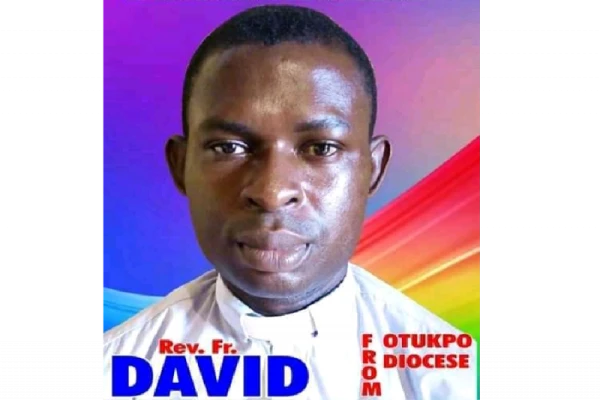
Otukpo, Nigeria, Mar 3, 2020 / 02:37 pm (CNA).- A Nigerian priest who was kidnapped after offering Sunday Mass March 1 has been freed, his diocese has reported.

“I have been reliably informed that Fr. David Echioda has been released by his abductors,” Nigeria’s Diocese of Otukpo said in a message to priests March 3.

“Thank you for your prayers and support during this trying time,” the diocese added.

Fr. David Echioda, who is assigned to ministry at Otukpo’s minor seminary, was abducted by gunmen as he returned to the seminary from his missionary outpost in central Nigeria, where he had been celebrating Mass.

The kidnapping is the latest in a series of abductions and killings in Nigeria which have involved Catholics and other Christians; clergy, seminarians, and lay people.

Archbishop Ignatius Kaigama of Abuja called on Nigerian President Muhammadu Buhari to address the violence and kidnappings in his homily March 1 at a Mass with the Catholic Bishops’ Conference of Nigeria.

“We need to have access to our leaders; president, vice president. We need to work together to eradicate poverty, killings, bad governance and all sorts of challenges facing us as a nation,” Kaigama said according to Naija News.

In February, another priest was kidnapped by gunmen in the state of Edo in the southwest region of the country.

Seminarian Michael Nnadi, 18, was killed in late January, weeks after he and three other seminarians were abducted from their seminary in Nigeria. The seminarians kidnapped with Nnadi have been released, but one is facing life-threatening injuries.

Boko Haram, an Islamist militant group that has sworn allegiance to the Islamic State, has been active in Nigeria for years. While the group has attacked both Muslims and Christians in the past, recent attacks have focused on the killing and kidnapping of Christians.

Also in January, Rev. Lawan Andima, a local Government Chairman of the Christian Association of Nigeria and the married father of nine children, was beheaded by Boko Haram.

Archbishop Augustine Obiora Akubeze of Benin City said Andima was killed “simply because he was a Christian.”

“This is the time to turn to God to save us and our dear country, Nigeria. We are told that once there is life there is hope,” Kaigama said. “We refuse to give in to pessimism. We are resilient, that’s why we are Nigerians.”

On Feb. 27, U.S Ambassador at Large for Religious Freedom Sam Brownback told CNA that the situation in Nigeria was deteriorating.

“There’s a lot of people getting killed in Nigeria, and we’re afraid it is going to spread a great deal in that region,” he told CNA. “It is one that’s really popped up on my radar screens — in the last couple of years, but particularly this past year.”

“I think we’ve got to prod the [Nigerian President Muhammadu] Buhari government more. They can do more,” he said. “They’re not bringing these people to justice that are killing religious adherents. They don’t seem to have the sense of urgency to act.”

On Ash Wednesday, last week, Catholics in the country were invited to wear black to highlight the ongoing violence against Chrisitans.

In a letter read in all the country’s parishes on Feb. 26, Archbishop Augustine Obiora Akubeze of Benin City, head of the country’s bishops’ conference, said that the black clothing would be a show of solidarity with victims of violent crime, as well as a display of mourning for victims of religious violence.

Also last week, the secretary general of the Catholic Secretariat of Nigeria issued a request for Catholics around the world to pray for peace in Nigeria and security for the nation’s Christians.

“I have been directed by the administrative board of the Catholic Bishops Conference of Nigeria (CBCN) to communicate to you that in the face of the current security situation, the Church needs to speak out in word and action against the level of insecurity in the country,” said Fr. Zacharia Nyantiso Samjumi on Feb. 25 to Nigerian press.

Samjumi said that Nigerians throughout the country live in a constant state of fear, and there is a ever-present state of insecurity. Christians are subjected to “repeated barbaric executions” and “incessant cases of kidnapping for ransom” by the Islamist group Boko Haram, and other terrorist organizations, he said.

The violence has “traumatized many citizens,” Samjumi concluded.


ACI Africa, CNA’s African news partner, contributed to the reporting of this story.

 

Read More

Suffering for the Sake of the Gospel

By Father Jordan Schmidt, OP | Sunday, March 8, is the Second Sunday of Lent (Year A).

Mass readings: Genesis 12:1-4; Psalm 33:4-5, 18-20, 22; 2 Timothy 1:8-10; Matthew 17:1-9.

The second…

Read More

Update on our travels and the coronavirus

I am keeping our pilgrims and others updated on my Footprints of God site at https://www.footprintsofgodpilgrimages.com/blog/concerns-about-travel-and-the-coronaviris/ Here is my latest update: UPDATE 3/3: In the United States there are currently 60 cases of corona virus with six deaths. The facts are stated as of today on the CDC site. There are also 10 people infected in […]

Read More

Colombian court says it cannot rule on abortion proposal

Following a flood of legal complaints from pro-life groups and groups favoring abortion, a judge in Colombia’s Constitutional Court proposed that abortion be permitted on request until the 16th week of pregnancy. On March 2, a majority of judges on the court said they could not vote on that proposal because the complaint that had begun the debate on abortion had been inadequately formulated.

Read More

6 Liturgical No-No’s During Lent

By Jimmy Akin | Like other liturgical seasons, Lent has its own special rules, and there are certain things that should not be done in Lent.

Here are 6 of them…


1. Instrumental music with no singing

In some parishes,…

Read More

Tornado hits historic Nashville church

Nashville, Tenn., Mar 3, 2020 / 11:00 am (CNA).- An historic Catholic church in the Nashville neighborhood of Germantown was among several buildings seriously damaged by a tornado Tuesday night.

The tornado’s main path struck about 100 yards awa…

Read More

R.I. Catholic school closes for week after coronavirus case reported

While school systems around the country are discussing what to do in response to the coronavirus, St. Raphael Academy in Pawtucket, Rhode Island, had to put its plans into immediate action when a member of the school community tested “presumptive positive” for a strain of coronavirus after participating in a recent school trip to Italy.

Read More

German bishops’ elect new conference chairman

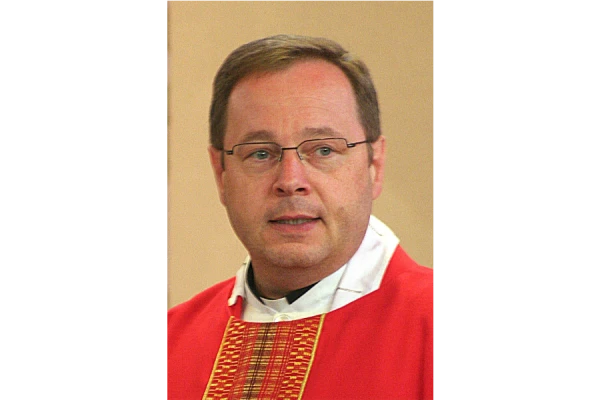
Mainz, Germany, Mar 3, 2020 / 10:30 am (CNA).- The German bishops’ conference has elected Bishop Georg Bätzing of Limburg as its new chairman. Bätzing replaces the outgoing chairman, Cardinal Reinhard Marx of Münich and Freising, and will lead the conference for a six year term.

The election of Bishop Bätzing was confirmed Tuesday, following a vote by the German bishops at their spring assembly, which is currently underway in Mainz. CNA Duetsch reported March 3 that, after no candidate received the necessary two-thirds majority during the first two rounds of voting, Bätzing was elected on the third ballot with a simple majority of votes cast.

The bishop used his first press appearance as chairman to reaffirm the conference’s support for the ongoing “synodal way” being conducted in partnership with the Central Committee of German Catholics (ZdK).

“At the center of our considerations is the ‘Synodal Way.’ I fully support that,” Bätzing said Tuesday.

The so-called binding synodal process formally opened during the first week of Advent, 2019, but the first meeting of the synodal assembly was convened in January. The assembly’s working groups will offer proposed changes to various aspects of Church teaching and discipline, including on women’s ordination, clerical celibacy, and human sexuality.

The 58 year-old Bätzing was consecrated bishop by Cardinal Rainer Maria Woelki on September 13, 2016.

Bätzing was asked Tuesday if some of the stated aims of the synodal process, in particular women’s ordination, had not been effectively ruled out by Pope Francis in his recent apostolic exhortation following the synod on the Amazon.

“On the contrary,” Bätzing said. The bishop explained that from his view the pope “did not take a position” on a number of questions posed in the final synodal document on the Amazon, and did not rule out any eventual conclusions of the German process.

Last year, Pope Francis wrote a letter to the whole Church in Germany, warning against allowing the Church conform to modern secular morals and thought. Pope Francis cautioned against “a new Pelagianism” which seeks “to tidy up and tune the life of the Church, adapting it to the present logic.”

The result of such errors, Francis said, would be a “well organized and even ‘modernized’ ecclesiastical body, but without soul and evangelical novelty.”

Vatican officials subsequently informed the German bishops’ conference that the synodal plans were “not ecclesiologically valid,” and called for them to be substantially revised.

As conference chairman, Bishop Bätzing will now co-chair the synodal assembly, along with the ZdK leadership.

Last month, Bätzing was elected to co-chair the synodal working group on “Life in Successful Relationships – Love Live in Sexuality and Partnership,” together with Birgit Mock, the ZdK spokeswoman on family policy. 

The ZdK has called for a total revision of Church teaching on homosexuality and for the blessing of same-sex relationships in churches.

In September, 2019, Bishop Bätzing co-chaired an ecumenical working group of Catholic and Protestant theologians which produced a document, titled “Together at the Lord’s Table,” which concluded that “mutual participation in the celebration of the Lord’s Supper / Eucharist is theologically justified.”

At the time of the document’s release, Bätzing noted that he had joined the group late in the process and initially asked himself “whether [he] can agree to this or not.”

“But I have to say, the theological justification in this basic paper is so clear to me that I did not want to and could not escape.”

In the Catholic Church, only baptized Catholics in a state of grace are permitted to receive Communion. The Code of Canon Law outlines very narrow circumstances in which non-Catholics may be admitted to Communion. While bishops in several northern European countries have repeatedly called for Eucharistic intercommunion, this has been rejected by Rome.

Acknowledging this at the time of the report’s release, Bätzing said that his own certainty on the issue did not mean he was free to alter sacramental discipline.

“However, this does not mean that I am a bishop alone, but the theological discussion must now be raised to the level of a teaching reception, i.e. an acceptance by the Magisterium of the Catholic Church. And this process is pending,” he said.

Read More

Pope Francis announces Laudato si’ Week to take place in May

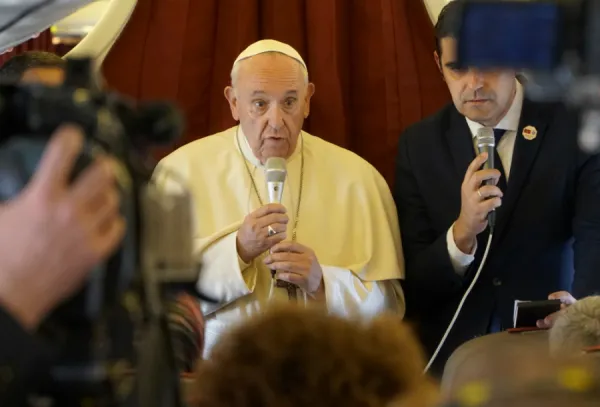
Vatican City, Mar 3, 2020 / 09:57 am (CNA).- Pope Francis is calling on Catholics to participate in “Laudato si’ Week” in May to encourage care for our common home.

“I renew my urgent call to respond to the ecological crisis. The cry of the earth and the cry of the poor cannot wait anywhere,” Pope Francis said in a video message published March 3.

The video shows young protesters yelling, “Climate justice, now” juxtaposed with images of wildlife in Africa and a beached whale.

Laudato si’ Week, sponsored by the Dicastery for Integral Human Development will take place May 16-24. The date marks the 5th anniversary of the publication of Pope Francis’ encyclical on integral human ecology.

The Global Catholic Climate Movement and Renova + are facilitating the campaign.

The Laudato si’ Week website recommends Catholics participate by engaging elected representatives, conducting an energy audit, or divesting in fossil fuels. It also recommends the option to “represent your commitment with a symbolic gesture,” such as planting a tree or attending a climate strike.

Laudato si’, which means “Praise be to You,” was published June 18, 2015, and was dated May 24. Pope Francis took the name for the encyclical from St. Francis of Assisi’s medieval Italian prayer “Canticle of the Sun,” which praises God through elements of creation such as Brother Sun, Sister Moon, and “our sister Mother Earth.”

The encyclical argues that it is not possible to effectively care for the environment without first working to defend human life.

It states that it is “clearly inconsistent” to combat the trafficking of endangered species while remaining indifferent toward the trafficking of persons, to the poor and to the decision of many “to destroy another human being deemed unwanted.”

Pope Francis also highlighted that concern for the protection of nature is “incompatible with the justification of abortion.”

“How can we genuinely teach the importance of concern for other vulnerable beings, however troublesome or inconvenient they may be, if we fail to protect a human embryo, even when its presence is uncomfortable and creates difficulties?” he asked.

The pope also addressed the highly-debated topic of population control, a proposed solution to problems stemming from poverty and maintaining a sustainable consumption of the earth’s resources.

“Instead of resolving the problems of the poor and thinking of how the world can be different, some can only propose a reduction in the birth rate,” Francis lamented.

He denounced the fact that developing countries often receive pressure from international organizations who make economic assistance “contingent on certain policies of ‘reproductive health.’”

“In the face of the so-called culture of death, the family is the heart of the culture of life,” Pope Francis wrote in Laudato si’.

“The urgent challenge to protect our common home includes a concern to bring the whole human family together … for we know that things can change,” he said.

Read More

Recent Comments

    Categories