St. Januarius’ blood liquifies for first time in 2022
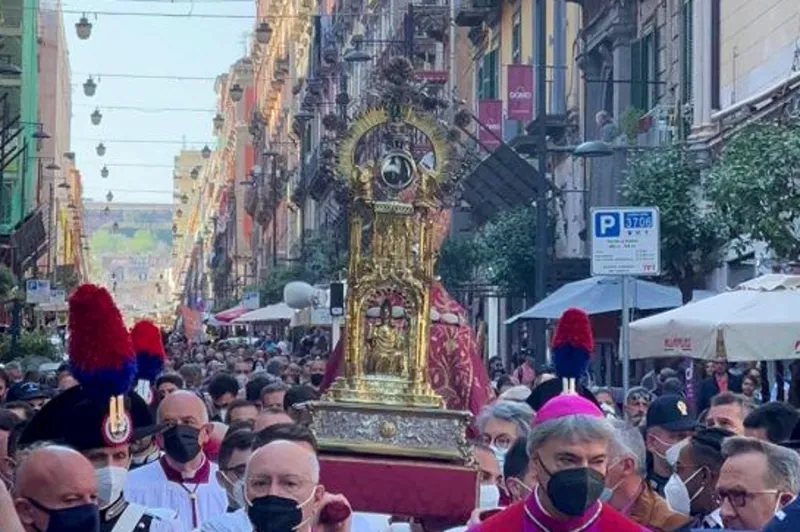
Archbishop Domenico Battaglia leads a procession in honor of St. Januarius in Naples, Italy, on April 30, 2022. / Jacob Stein’s Instagram account Crux Stationalis.
Rome Newsroom, May 3, 2022 / 08:10 am (CNA).
For the first time in three years, Catholics held a solemn procession through the streets of Naples on the first weekend of May after the blood of St. Januarius was found liquefied.
Archbishop Domenico Battaglia of Naples opened the safe holding the relic of St. Januarius’ blood in Naples Cathedral on April 30 and found that the blood had already liquefied.
The reputed miracle usually occurs up to three times a year when the archbishop holds up and rotates the ampoules containing blood, revealing that the dried blood has liquified.
In Neapolitan lore, the failure of the blood to liquefy signals war, famine, disease, or other disaster.
Local Catholics gathered at the cathedral after 5 p.m. on April 30 and exclaimed: “The miracle has happened!”
A bust of St. Januarius and the ampoules holding the saint’s blood were then carried in a traditional procession through the narrow streets of Naples from the cathedral to the Basilica of St. Clare.
Jacob Stein, an American, and a friend were visiting Naples when they stumbled upon the procession with the relic of St. Januarius, who is known in Italian as San Gennaro.
“My friend and I looked at each other and said, ‘I guess we are processing with San Gennaro tonight,’” Stein told CNA.
“Shoulder to shoulder, we processed behind San Gennaro who had come from the Duomo [cathedral] and ended at the Monastery of Santa Chiara with Holy Mass. On the streets, many were looking from the windows and balconies. You could hear ‘Alleluia’ and ‘Viva, San Gennaro!’ as we passed the piazzas.”
“The occasional confetti gun went off above our heads, as Neapolitans joined the procession in the many-layered, chaotic yet full expression of their religious procession throughout the small streets of Naples.”
Januarius’ blood also liquefied in May 2020 and 2021, but the celebratory processions were canceled due to the COVID-19 pandemic. The May 2019 procession was canceled due to adverse weather conditions.
During the Mass to mark the liquefaction, Archbishop Battaglia highlighted St. Januarius’ faithfulness to the Gospel by following Jesus to the point of martyrdom.
St. Januarius, the patron saint of Naples, was a bishop in the third century who is believed to have been martyred during the Christian persecution of Emperor Diocletian.
“If we are here tonight it is because Bishop Januarius took this Word seriously, following the Lord Jesus to the end, even to the point of shedding his blood, even to the point of giving his life, knowing that there is no greater love than one who gives his life for his friends,” Battaglia said in his homily.
The archbishop also condemned the violence he has witnessed in the city of Naples since his installation in 2020.
“Too many times in this still short time I have lived here in Naples have I had to caress the faces of young mothers wounded by the unprecedented pain of the loss of their child, killed through no fault of their own, perhaps in the context of an argument between boys,” he said.
The 59-year-old archbishop said that the sign of the liquefaction of Januarius’ blood was an invitation to the people of Naples to work to “stop the flow of innocent blood, the hands of brothers who hurl themselves against brothers, the wounds that tear the social, educational, economic fabric of our city and the whole world.”
He asked for St. Januarius’ intercession to stop not only the violence in his archdiocese, but also to bring an end to the “blood still flowing” in the war in Ukraine.
“How important is all this in such a complex, difficult, heavy time in which the blood of our martyr Januarius, a luminous sign of the blood of the One who loved us by offering Himself for us on the cross, continually reminds us of the blood of so many small, innocent victims of evil, violence, malfeasance, and war,” Battaglia said.
Stein and his friend experienced some of the crime in the city of Naples on a small scale when they were mugged the day after the procession.
“After we recovered, we were walking to the police station to make the formal declaration of the theft. We passed a group of teenagers preparing a processional float with lilies for the Madonna dell’Arco at the start of May. They called out to us, there will be a procession at 4:30 p.m., beginning just around the corner from where we were accosted,” he said.
A local couple also invited Stein and his friend into their home for a few hours and offered them coffee, cigarettes, bruschetta, pasta, and wine.
The liquefaction of St. Januarius’ blood traditionally happens three times a year: the first Saturday of May, Sept. 19, the saint’s feast day, and Dec. 16, the anniversary of the 1631 eruption of nearby Mount Vesuvius.
Read More
 For four centuries, America has been built on the development of agriculture. Nowhere is that revealed more than in America’s heartland, stretching from the Great Lakes region through the Great Plains. Sitting right in the middle of this stretch of geography resides Peoria, Illinois, rising up in the midst of a vast sea of farmland. […]
 The end of Roe may be near—what does this mean for the future of America?
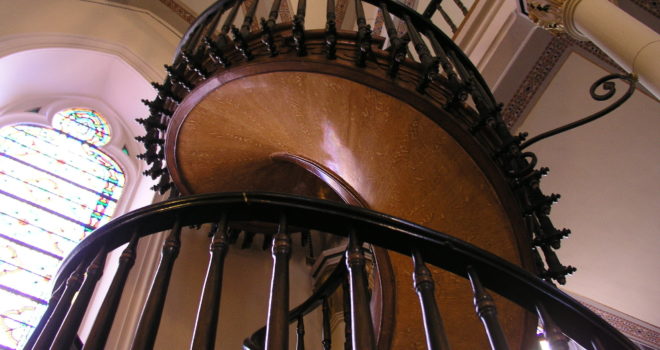 Last year marked 140 years since the completion of the most famous staircase in our nation. It’s in the chapel of Our Lady of Loretto in Santa Fe, New Mexico. I hope that you know the story. In the 1870s in New Mexico, despite all the surrounding structures made of adobe, it was decided that […]
 Several years ago, a young woman began to have debilitating headaches daily. When her doctor conducted tests, it was found that she had a rare neuro eye disorder, and had begun losing her peripheral eye sight. If medication didn’t work, she might need to have a shunt implanted in her brain and could go blind. […]
 Autists know that too often campaigns to eradicate autism are, in fact, campaigns to eradicate them.
 I am traditional, but not because, as “progressives” often say, I want to go back to the time of “Pre-Vatican II,” or “the fifties.”
Recent Comments