Federal Court Orders Cases Brought Against Texas Pro-Life Law Dismissed
cna
Read MoreSelect Page
Pregnancy Test. / Flickr/Ernesto Andrade.
Denver Newsroom, Apr 27, 2022 / 14:19 pm (CNA).
A federal court on Tuesday ordered a lower court to dismiss all legal challenges brought against the enforcement mechanism of a Texas abortion law, a move…
Posted by bcadmin | Apr 27, 2022 | In the News, News |
Bill in the news (The Wrap): Catholic League President Bill Donohue calls for Rep. Marjorie Taylor Greene to apologize for slandering the Church. READ MORE HERE
Read More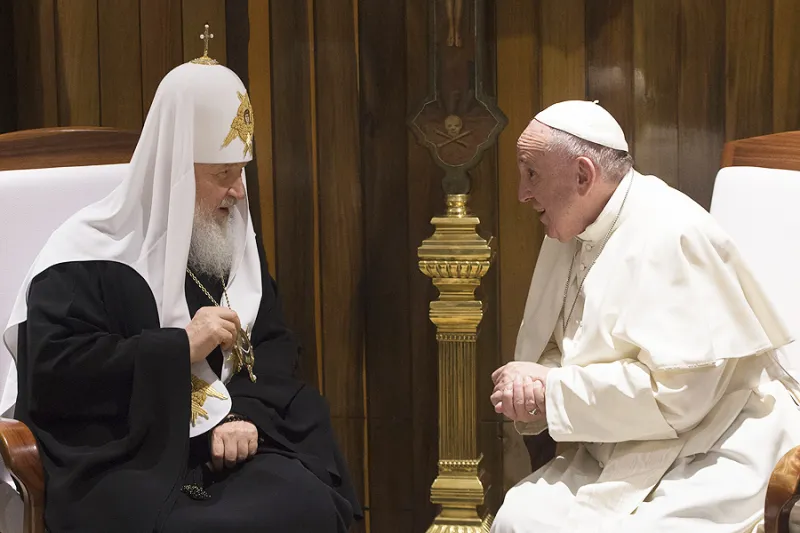
Rome Newsroom, Apr 27, 2022 / 12:15 pm (CNA).
The long-awaited second meeting between Pope Francis and the head of the Russian Orthodox Church will not take place for now. The pope himself announced the news in an interview with the Argentine newspaper La Nacion published on April 22.
So we will have to wait longer for the next encounter between the pope and Patriarch Kirill of Moscow and All Russia. This allows further time to consider where the two Church leaders could eventually meet.
One location spoken about behind the scenes is Bratislava, the capital of the Central European country of Slovakia, which the pope visited last September.
Pope Francis told reporters as he returned from Malta earlier this month that the Middle East was being considered as a possible location for the meeting, thus confirming rumors that had spread since the start of 2022.
When Lebanese President Michel Aoun announced that Pope Francis would visit Lebanon on June 12-13, some concluded that the summit would take place in the Land of the Cedars. But the organizers had from the beginning intended the meeting to take place in Jerusalem, perhaps just after the Lebanon trip.
Jerusalem was considered an ideal location for various reasons. For one, the Moscow Patriarchate does not view it as a place where the Orthodox are discriminated against. It is, above all, a neutral territory outside of Europe, where Catholic-Orthodox tensions persist.
The historic first meeting between Pope Francis and Kirill took place at Havana airport in Cuba, another country outside Europe where the Orthodox do not consider themselves to be persecuted.
There was another idea: to echo in Jerusalem the landmark embraces of Athenagoras I and Paul VI in 1967 and Bartholomew I and Pope Francis in 2014. This act would have made it clear that both the Ecumenical Patriarchate of Constantinople and the Patriarchate of Moscow have strong friendships with Rome.
For Moscow, it would have been a highly symbolic gesture, considering the climate of hostility that has existed with Constantinople since it recognized the Orthodox Church of Ukraine, an autocephalous church that no longer depended on the Moscow Patriarchate as the Ukrainian Orthodox Church had since the 17th century.
But paradoxically, the factors that made a Jerusalem meeting an attractive option prompted the pope to cancel the encounter — at least for now.
The Holy See did not want the potential meeting to be exploited amid the Russia-Ukraine war and it did not want to be drawn into intra-Orthodox debates.
While the meeting has been postponed, could it ultimately take place in Kazakhstan — another venue that has been mentioned for some time?
Kazakhstan’s government has announced that Pope Francis will visit the country on Sept. 14-15 to participate in the Congress of Leaders of World and Traditional Religions. According to a project defined even before the pandemic, Patriarch Kirill was also invited to the gathering.
But the possibility of a meeting in Kazakhstan also had a downside: the Central Asian country’s link with its neighbor Russia. Kazakhstan is the canonical territory of the Moscow Patriarchate.
Another possible location mentioned was Hungary. This hypothesis was based on the desire that Pope Francis expressed to return to the country that he visited for a single day last September.
The suggested venue was Pannonhalma Archabbey, one of Hungary’s oldest historical monuments. This was considered in 1996 as a possible meeting place between Pope John Paul II and the then head of the Russian Orthodox Church Alexy II. The encounter did not, of course, take place.
The idea would have been for Pope Francis’ trip to coincide with a visit to Hungary by Patriarch Kirill, marking the restoration of the Orthodox cathedral in Budapest or the inauguration of the new Russian Orthodox church in Hévíz, western Hungary.
But this hypothesis faded away, to be replaced by the idea of a meeting in Slovakia, a country that the pope called “a message of peace in the heart of Europe” during his September trip.
The proposal of a meeting between Francis and Kirill in the capital Bratislava was advanced by Ján Figeľ, the special envoy of the European Union for religious freedom from 2016 to 2019.
Why Bratislava? Partly because it is the capital of a country that borders Ukraine and is receiving refugees from the war-torn Eastern European country. And also because it is a nation at the center of Europe, the continent that experienced Soviet oppression and knows the need for reconciliation.
“Peoples and the Church,” Ján Figeľ told CNA, “need to share important messages and commitments of loving faith and truth, courage, peace, reconciliation, and brotherhood, now mainly in and for Europe.”
He added that, “conscious of the historical spiritual and political divisions in Europe, and facing the reality of bloody conflict in the east of Europe, we must urgently converge our effort towards true Christian brotherhood and unity on this continent, where Christianity gave roots and orientation to its cultures and identities.”
Slovakia is a bridge between East and West. The opening lines of its constitution refer to the “the spiritual bequest of Cyril and Methodius,” the “Apostles to the Slavs” who are venerated by both Catholics and Orthodox Christians.
John Paul II spoke of a Europe that needed to breathe with two lungs — eastern and western — and for Figeľ, “this grand vision is still possible and achievable.”
“But the war must end,” he said, “and its consequences cannot represent any imperial expansion of Russia, religious or mental triumphalism, but an actual conversion of Eastern European nations to truth, respect for the dignity of all, proper reconciliation, and shared responsibility.”
Therefore, Bratislava is a strong candidate to be a meeting place for the pope and the Moscow patriarch, the first of its kind in Europe.
Figeľ added that the potential meeting could also “gather together other groups of goodwill, organized lay Christians,” faith-based organizations, and civil society organizations.
“For example, the ICLN [International Catholic Legislators Network] and the IAO [Interparliamentary Assembly on Orthodoxy] could start their regular biannual joint meetings in the center of Europe,” he suggested.
In this way, Figeľ said, the meeting “may inspire and encourage the missing post-war process of reconciliation and integration in Eastern Europe as we witnessed in Western Europe, starting with France and Germany under Robert Schuman’s plan.”
“Importantly as well, the name of the city [Bratislava] resonates exceptionally with the Holy Father’s repeated calls for human fraternity. Indeed, ‘brati’ and ‘slava’ in the Slovakian language mean ‘Glory to brothers,’ ‘Glory to brotherhood,’ as ‘brat’ means brother and ‘slava’ is glory. This meaning is the same in other Slavic languages. So, the pope and the patriarch can express, confirm, and visualize their brotherhood in Bratislava in the center of the two Christian and European lungs.”
Figeľ noted that the Holy See, led by Pope Pius XII, had been a “very active supporter” of the reconciliation process in Western Europe.
“Many people hope to stop this war soon,” he said. “After transitional justice and punishment of crimes, an updated Marshall Plan for the reconstruction of Ukraine must follow and an offer of a new, values- and rules-based supranational cooperation oriented towards peace, justice, and the common good, with the vision of integration of Eastern countries into one community, representing Europe whole and free, in a common European house.”
This proposal is now before Pope Francis and Patriarch Kirill, as well as their respective advisers, the Vatican Secretary of State Cardinal Pietro Parolin and Metropolitan Hilarion in Moscow. Naturally, the moment needs caution, and every meeting must be considered carefully. But every possibility must also be explored.
Read More
Pope Francis’ general audience in St. Peter’s Square, April 27, 2022. / Vatican Media.
Vatican City, Apr 27, 2022 / 11:50 am (CNA).
Pope Francis told pilgrims at his Wednesday general audience that he was unable to stand to greet them because h…
Posted by bcadmin | Apr 27, 2022 | In the News, News |
Bill in the news (Mediaite): Catholic League President Bill Donohue calls for Rep. Marjorie Taylor Greene to apologize for slandering the Church. READ MORE HERE
Read MorePosted by bcadmin | Apr 27, 2022 | Homeless, News, nihilism, Rod Dreher, Russia, The Dispatch, trangenderism |
Children of Men – Why Russia can’t afford to spare its young soldiers anymore. ‘Children of Men’ is really happening (Ed West, Substack) Latin evangelicals – “Catholicism is in swift decline, although there are growing […..
Read MorePosted by bcadmin | Apr 27, 2022 | Latest News Releases, News |
Catholic League president Bill Donohue comments on Rep. Marjorie Taylor Greene: Rep. Marjorie Taylor Greene gave an interview on April 21 to Michael Voris, the head of Church Militant, wherein they discussed the role of Catholic Charities assisting ill…
Read MorePosted by bcadmin | Apr 27, 2022 | Latest News Releases, News |
Catholic League president Bill Donohue comments on Harvard’s attempt to deal with its legacy of slavery: Slavery has existed in every part of the world, and it was rarely considered to be morally wrong until Christianity condemned it. In fact, when the…
Read More
Cardinal Carlos Amigo Vallejo (1934-2022). / Miguel Ángel fotógrafo via Wikimedia (CC BY-SA 3.0).
Rome Newsroom, Apr 27, 2022 / 09:20 am (CNA).
Spanish Cardinal Carlos Amigo Vallejo, an advocate for dialogue between Christians, Muslims, and Jew…
Posted by bcadmin | Apr 27, 2022 | News, United States |
Cardinal Timothy Dolan of New York is to visit Poland and Slovakia this week to meet Ukrainian refugees. The purpose of the visit is to demonstrate solidarity with the victims of the conflict, with the cardinal being taken around receiving centres along the Polish and Slovak borders with Ukraine, as well as in Kracow and
The post New York cardinal on mercy mission to Ukraine refugees appeared first on Catholic Herald.
Read More We probably have experienced this before in our faith journey: we have a time of strong faith followed by a time of deep doubt in God. One moment we are filled with faith and courage in following the Lord Jesus Christ. The next moment we find ourselves filled with doubts and insecurities, easily succumbing to […]
Posted by bcadmin | Apr 27, 2022 | Catholic, Catholic Cooking, Catholic man, Etiquette, Faith and Cooking, fasting, Feast and Fast, Feasts, Featured, Masculinity, News, podcast |
Today Sam and John are joined by a culinary chef and Catholic, Jim Churches to discuss his life as a chef and how we as men can appreciate and find a deeper meaning in food. We talk about his life as a professional chef, his Catholic faith and how it enters his kitchen, how to make an amazing steak, and what one ingredient makes everything better.
The post Finding Joy and Faith in Cooking appeared first on The Catholic Gentleman.
Read More
Recent Comments