Mother Teresa’s revolution of tenderness
What kept Mother Teresa smiling, enabled her to tenderly hold an orphan, attend to a leper, or care for an…
The post Mother Teresa’s revolution of tenderness appeared first on The Catholic Thing.
Read MoreSelect Page
Posted by bcadmin | Feb 3, 2022 | Commentary, News |
What kept Mother Teresa smiling, enabled her to tenderly hold an orphan, attend to a leper, or care for an…
The post Mother Teresa’s revolution of tenderness appeared first on The Catholic Thing.
Read MorePosted by bcadmin | Feb 3, 2022 | In the News, News |
New and old members of Benedict XVI’s “schülerkreis” — a theological discussion group Archbishop Joseph Ratzinger founded in 1978 for…
The post ‘Schülerkreis’ defends Benedict XVI appeared first on The Catholic Thing.
Read MorePosted by bcadmin | Feb 3, 2022 | In the News, News |
Pope Francis has suspended talks between the Vatican and the Sovereign Military Order of Malta, after weeks of tense negotiations…
The post Pope: I’ll settle Malta disputes appeared first on The Catholic Thing.
Read MorePosted by bcadmin | Feb 3, 2022 | Commentary, News |
Yesterday we celebrated the Presentation, commemorating Simeon’s recognition of the infant Jesus as “a light for revelation to the Gentiles.”…
The post On the Presentation of the Lord appeared first on The Catholic Thing.
Read More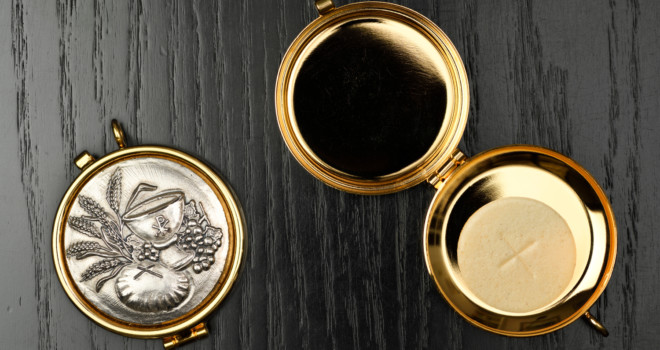 I bring Holy Communion to my parish’s homebound. Because my visits are regular and sometimes continue for years, I have the privilege of developing relationships with many of the communicants. They become friends. Old friends, I like to joke, because most of them are in their nineties. Born in the 1920s, a few of them […]
Posted by bcadmin | Feb 3, 2022 | "ignorant armies clash by night", 2022, Columns, dark ages, Medieval Philosophy, Middle Ages, News, Ratzinger prize, Rémi Brague’s Curing Mad Truths: Medieval Wisdom for the Modern Age, Robert Royal, Roger Scruton's Philosopher on Dover Beach, Royal's Our Darkling Plain, St. Augustine's Confessions, The Catholic Thing, “Dover Beach” by Matthew Arnold |
Robert Royal on Rémi Brague’s new book, which argues we must be able to tell why the existence of human beings on this earth is a good thing.
The post Our Darkling Plain appeared first on The Catholic Thing.
Read MoreThe Pope turned his attention at the February 2, 2022, General Audience to the Communion of Saints, calling it an expression of God’s love.
Read MoreSt. Blaise enjoyed widespread veneration in the Eastern and Western Churches due to many cures attributed to him. According to tradition, he was Bishop of Sebaste in Armenia and was martyred under Licinius. On this day the Church gives a “Blessing of t…
Read MoreThe bishops of the Maronite Catholic Church have voiced concern that Lebanon could become the battleground for “proxy wars” by other countries, adding that such conflicts should not be misunderstood as “internal conflicts” withi…
Read MoreAt a February 3 audience with members of the Inspectorate for Public Security, Pope Francis thanked the officials for their work in maintaining order around the Vatican, particularly during the trying times of the Covid epidemic. Complimenting them for…
Read MoreBishop Antonio Suetta of Sanremo has angrily protested a performance at the Sanremo music festival, in which a singer made obscene gestures while simulating a baptism.
The show was “not just offensive to religion, but to human dignity,” th…
A coalition of Christian leaders has called upon the government of Hong Kong to releases Jimmy Lai and other democracy activists, suggesting that the gesture would be appropriate for the Chinese New Year.
The statement—signed by Cardinal Charles…
Cardinal Malcolm Ranjith of Colombo has announced that he will not participate in Sri Lanka’s independence-day celebrations on February 4, as a protest against the government’s failure to investigate the recent discovery of a hand grenade i…
Read MorePosted by bcadmin | Feb 3, 2022 | Apologetics, News, Protestant/Other Christians, Theology |
If you would like to join in on the lively discussion I had with Bryan Mercier. He described it as,
“Catholic vs Protestant (on salvation) Former Fundamentalist Baptist Steve Ray speaks about salvation and how to be saved. He shows why Protestant…
It was a secret meeting. On Oct. 24, 1999, the Vatican’s top officials met at the Congregation for the Clergy in Rome’s Piazza Pio XII, all the cardinal prefects of the relevant congregations and their […]
Read MoreToday, we celebrate the feast of Our Lord’s Presentation, in the Temple, characterized by the mention of light. But who is the light? As the Gospel of John squarely tells us, Christ is the Light. I am personally touched by some 24 times which the Fourth Evangelist used the word light. Obviously, in this gospel[…]
The post The Feast of the Presentation of Our Lord and Consecrated Life appeared first on Catholic Insight.
Read MorePosted by bcadmin | Feb 3, 2022 | News, The Dispatch |
While walking recently through Andy Warhol: Revelation at the Brooklyn Museum, I came across a display of Warhol’s holy card collection. One of them included a card of Pope St. Paul VI. “I wonder if […]
Read MoreQuestions Covered
8:05 – The Church Fathers say the body is the same before and after the fall and the resurrection. What does that mean?
14:39 – I was talking to my sister who is an atheist and believes in the spirit realm. How would you …
Special day aimed at promoting interreligious and intercultural dialogue requires reaching out to others, respecting them, and listening to them, says Francis
Read More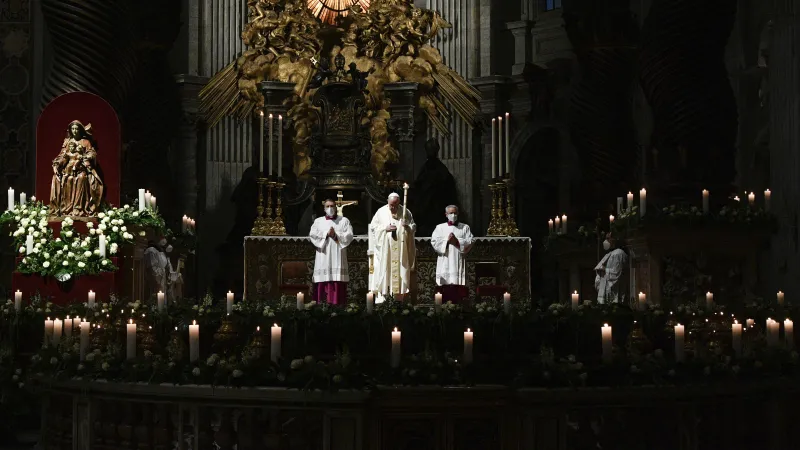
Vatican City, Feb 2, 2022 / 16:41 pm (CNA).
The amazed joy of Simeon and Anna at encountering and embracing Christ at the Temple is a virtue that consecrated religious should remember and imitate, the pope said in a homily addressed to religious brothers and sisters.
He encouraged consecrated religious to renew their consecration with enthusiasm and to scrutinize themselves for worldliness, bitterness, and empty rigidity.
“Even if we experience fatigue and weariness—this happens: even disappointments, it happens—we do as Simeon and Anna, who patiently await the Lord’s fidelity and do not allow themselves to be robbed of the joy of the encounter,” Pope Francis said in his homily during a Feb. 2 Mass for the feast of the Presentation of the Lord.
The occasion marked the 26th Day of Consecrated Life.
“Let us go towards the joy of the encounter: this is very beautiful! Let us put (the Lord) back at the center and go forward with joy,” the pope said. His homily drew on the reading from the Gospel of Luke recounting the Presentation of Christ in the Temple.
Simeon welcomed Christ in his arms, the pope noted.
“God placed his Son in our arms because welcoming Jesus is the essential, the central point of faith,” he continued. “Sometimes we risk getting lost and dispersed in a thousand things, fixing ourselves on secondary aspects or immersing ourselves in things to do, but the center of everything is Christ, to be welcomed as the Lord of our life.”
Those in consecrated life must not lose their ability to be amazed, the pope said. Simeon had this ability: he uttered words of blessing, praise, and amazement when he took Christ into his arms.
“Ask for the grace of amazement, the amazement at the wonders that God is doing in us, hidden like that of the temple, when Simeon and Anna met Jesus,” the pope told the congregation of consecrated religious brothers and sisters.
“If the consecrated lack words with which they bless God and others, if there is no joy, if the momentum is lacking, if fraternal life is only fatigue, if there is no amazement, it is not because we are victims of someone or something,” he said. “The real reason is that our arms do not hold Jesus more tightly. And when the arms of a consecrated person do not hold Jesus, they hold emptiness. They try to fill their arms with other things, but there is emptiness. Clasp Jesus with our arms: this is the sign, this is the path, this is the ‘recipe’ for renewal.”
The failure to embrace Christ means “the heart closes in bitterness,” the pope warned. Consecrated persons who are bitter “always complain about something,” like the community superior, its religious brothers, the community in general, or its kitchen.
“If they have no complaints, they do not live,” the pope lamented. “But we must embrace Jesus in adoration and ask for eyes that know how to see good and see God’s ways. If we welcome Christ with open arms, we will also welcome others with trust and humility. Then conflicts do not escalate, distances do not divide and the temptation to abuse and hurt the dignity of some sister or brother is extinguished. Let us open our arms, to Christ and to the brothers and sisters!”
Simeon and Anna waited in an active way, not a passive one, according to Pope Francis. He stressed the action of the Holy Spirit in the gospel reading: “it is He who makes God’s desire burn in Simeon’s heart… it is He who pushes his steps towards the temple and makes his eyes capable of recognizing the Messiah, even if he presents himself as a small and poor child.”
The Holy Spirit, the pope continued, “makes one capable of perceiving the presence of God and his work not in the great things, in the showy exterior, in the displays of strength, but in littleness and fragility.”
The pope encouraged consecrated religious to scrutinize their motivations and to ask themselves whether they let themselves be moved by the Holy Spirit or by “the spirit of the world.”
“While the Spirit leads us to recognize God in the smallness and fragility of a child, we sometimes risk thinking about our consecration in terms of results, goals, success: we move in search of spaces, visibility, numbers: it is a temptation. The Spirit, on the other hand, does not ask for this. He wants us to cultivate daily fidelity, docile to the little things that have been entrusted to us,” Pope Francis said.
He also praised the beautiful fidelity of Simeon and Anna, as shown in their daily visits to the temple to wait and pray even if nothing seems to happen. They waited their whole life without discouragement or complaint.
The pontiff offered more questions for reflection: “What love drives us to move forward? The Holy Spirit or the passion of the moment, which is anything? How do we move in the Church and in society?”
“Sometimes, even behind the appearance of good works, the worm of narcissism or the craving to be the leading character can be hidden,” he warned. Other religious communities, even while doing good things, seem motivated by “mechanical repetition” rather than “the enthusiasm to adhere to the Holy Spirit.”
He encouraged the congregation to reflect on what their eyes see.
“Simeon, moved by the Spirit, sees and recognizes Christ. And he prays, saying: ‘My eyes have seen your salvation’,” the pope continued. “Here is the great miracle of faith: he opens his eyes, transforms the gaze, changes the view.”
“As we know from many encounters of Jesus in the Gospels, faith is born from the compassionate gaze with which God looks at us, melting the hardness of our heart, healing his wounds, giving us new eyes to see ourselves and the world.”
This new vision is not naïve, but wise. It sees even the “most painful” things. It does not ignore reality or pretend that problems are invisible. Rather, one’s eyes must know how to “see within” and to see beyond appearances.
“The elderly eyes of Simeon, although tired from the years, see the Lord, they see salvation,” the pope said.
He lamented some worldly attitudes that see religious life as a “waste” for men or women, or see it as outdated or something useless. He also warned religious communities against “looking backwards” or nostalgia “for what no longer exists.” Rather, they should be capable of “a far-sighted gaze of faith,” capable of hopeful vision that is open to the future.
God gives signs inviting us “to cultivate a renewed vision of consecrated life.”
He warned about a rigid approach to tradition that pretends not to see these signs and continues“as if nothing had happened, “repeating the same things as always, dragging ourselves by inertia into the forms of the past, paralyzed by the fear of change.”
He also warned against “the temptation to go backwards, out of security, out of fear, to keep the faith, to keep the founding charism.”
“Let’s get it right: rigidity is a perversion, and under every rigidity there are serious problems,” he said.
Even in their old age, Simeon and Anna did not show regret for the past but “they open their arms to the future that comes to meet them.”
“Neither Simeon nor Anna were rigid, no, they were free and had the joy of celebrating: him, praising the Lord and prophesying with courage to his mother; and she, like a good old lady, going from side to side saying: ‘Look at these, look at this!’ They gave the proclamation with joy, their eyes full of hope. No past inertia, no stiffness.”
Even behind genuine crises, including a lack of vocations, the Holy Spirit “invites us to renew our life and our communities,” and God will show the way to do this for those who open their hearts with courage and without fear.
“Let us place ourselves before the Lord, in adoration, and ask for eyes that know how to see the good and see the ways of God. The Lord will give them to us, if we ask for it,” said the pope.
Read More
Recent Comments