Select Page

Month: June 2020

They Might Be Saints: Father Patrick Peyton

By Michael O’Neill | Michael O’Neill’s They Might Be Saints: Father Patrick Peyton premieres on EWTN at 1:30 p.m. Eastern on Wednesday, June 3, and encores at 11 p.m. Eastern on Thursday, June 6.


Staring his own mortality…

Read More

On Hope and the Holy Spirit

By Regis Martin | When a word is spoken, does anything happen? Take the word hope, for instance. When you hear it, does anything at all compute? In other words, will it signify in your mind some extra-mental reality, or is it…

Read More

#9609 Open Forum – Tim Staples

Callers choose the topics during Open Forum, peppering our guests with questions on every aspect of Catholic life and faith, the moral life, and even philosophical topics that touch on general religious belief. 
Questions Covered:

06:07 – If one…

Read More

Don’t Give Up the Ship! Spiritual Warfare with Navy Discipline

buckley navy

On a frigid December evening in 2012, thirty-five of us lowly officer candidates at Navy Officer Candidate School (OCS) line up outside the base’s dining hall in Newport, Rhode Island. After another grueling day of military drill practice, academic classes, […]

The post Don’t Give Up the Ship! Spiritual Warfare with Navy Discipline appeared first on OnePeterFive.

Read More

Minneapolis archbishop, priests join in prayerful George Floyd protest

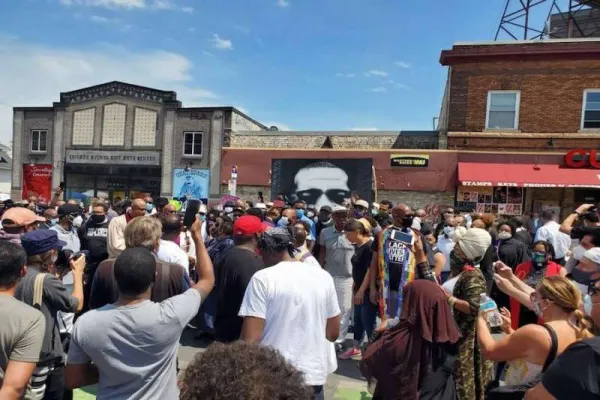
Denver Newsroom, Jun 2, 2020 / 05:38 pm (CNA).- Minneapolis clergy, including Archbishop Bernard Hebda of St. Paul-Minneapolis, participated in a silent walking protest Tuesday afternoon to the spot where George Floyd died in police custody last week, stopping to pray at the memorial that had been set up for him.

Hundreds of local leaders from Christian denominations and other religious traditions were present for the prayerful event.

“While many faiths were represented, there was great unity as we prayed for justice and peace,” Archbishop Hebda said in a tweet Tuesday.


It was a great privilege to pray alongside faith leaders #stpfaithleadersforjustice in our communities today both in Minneapolis and Saint Paul. While many faiths were represented, there was great unity as we prayed for justice and peace. pic.twitter.com/q9ULUGeu3V

— Bernard Hebda (@ArchbishopHebda) June 2, 2020


Archbishop Hebda had offered a Mass for the soul of George Floyd and for his family May 27.

Other Catholic cergy present included Father Kevin Finnegan, pastor of Our Lady of Grace Parish southwest of the city. Father Finnegan was glad to see Archbishop Hebda at the protest, though “he was not at all the center of attention.”

“I ended up being “up front” for the prayer part…not where I intended,” Finnegan told CNA in an email.

“But a [great] place to ask God to grace our community.”

Dozens of cities across the country have seen widespread protests in the wake of the death of George Floyd. Some protests have turned to nights of rioting, or conflicts with police. At least five people have died amid the protests.

In the video of the May 25 arrest, an officer with the Minneapolis Police Department can be seen kneeling on Floyd’s neck for several minutes after the man was taken into custody. Floyd could be heard saying “I can’t breathe” several times. Floyd died soon after.

Former Minneapolis police officer Derek Chauvin was arrested May 29, and has been charged with third-degree murder and manslaughter. He and the three other officers present at Floyd’s arrest were fired from the Minneapolis Police Department.

Catholics across the Twin Cities have called for justice and unity in the wake of Floyd’s death.


Hundreds join Mpls clergy on silent march to block where George Floyd was killed by Minneapolis police officer. Diverse crowd prayed at memorial that has become sacred ground. pic.twitter.com/zZUgIPxIKP

— maury glover (@maurygloverFOX9) June 2, 2020


“The love of God, revealed in Jesus Christ, clearly shows us that we are all children of one God, and that we are all equally subjects of Christ our King, in the Kingdom of God our Father. We are all brothers and sisters,” Fr. Erich Rutten, pastor of St. Peter Claver Parish in St. Paul, said in a YouTube message May 27.

“This particular case is so egregious, that it’s just maddening,” Rutten— who shepherds the largest African-American Catholic community in the Twin Cities— told CNA.

“Our faith calls us way beyond racism, into a radical unity, in the Kingdom of God. A Kingdom we’re all brothers and sisters. I mean truly: Really brothers and sisters,” he said.

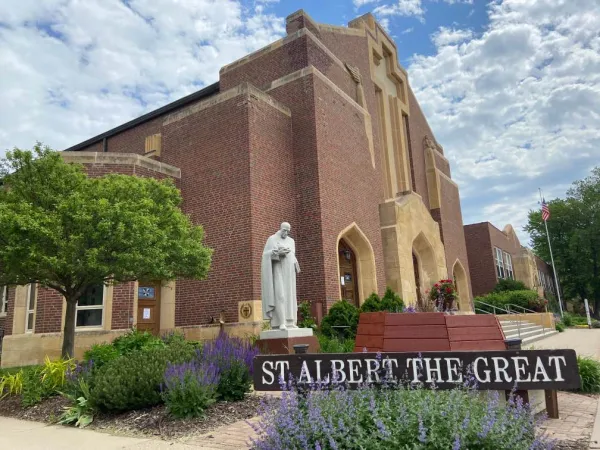
St. Albert the Great Parish, located in the Longfellow neighborhood, sheltered 34 neighbors as riots destroyed surrounding businesses and damaged homes the night of May 28. Less than a mile from the church, thousands of protesters gathered to burn the Minneapolis Third Police Precinct, many of them inflicting violence on the surrounding area as well.

The Basilica of Saint Mary in Minneapolis sustained fire damage May 29 amid riots in the city, and graffiti was found on the Church of St. Mark in St. Paul, over two miles away from the heart of the violence.


Read More

#9608 Open Forum – Tim Staples

Callers choose the topics during Open Forum, peppering our guests with questions on every aspect of Catholic life and faith, the moral life, and even philosophical topics that touch on general religious belief. 
Questions Covered:

02:38 – Why is…

Read More

Can Trump legally deploy troops? Yes, say Catholic university law profs

Washington D.C., Jun 2, 2020 / 05:00 pm (CNA).- After President Donald Trump announced Monday that he is ready to send U.S. troops into states to quell riots, law professors at Catholic universities said acting against the wishes of state governors would be counterproductive, but likely would not violate the law.

Mass protests and some riots have occurred in major U.S. cities and suburbs since shortly after the May 25 death of George Floyd in Minneapolis. While 23 states have mobilized the National Guard to quell rioters, on June 1 Trump said he would deploy U.S. troops in states that have not done so.

Legal experts told CNA that the Insurrection Act, a law approved by Congress in 1807 and amended over the years, that allows the president to use the military on American soil in times of insurrection. But the statute is subject to a number of limitations, they said, and has historically been used in cooperation with state governors and not against their wishes.

Professor Mary Ellen O’Connell at the University of Notre Dame Law School said Trump “has a narrow statutory right” to send the U.S. military into states, but that in her judgment, “the right does not apply to the current civil unrest.”

Trump cited the need to maintain law and order during a period of unrest, O’Connell said, but the current protests and riots have been created, in part, because of recklessness by law enforcement through “militarized policing.”

“Our nation is witnessing the impact of excessive force, not the lack of it. Excessive force was used against George Floyd. It is being used by some seeking justice for him. It will not end with the deployment of military fire power,” O’Connell said.

In the White House Rose Garden on Monday, President Trump said that he would deploy the U.S. military to states to quell riots, if state governors did not call up the National Guard.

“Today, I have strongly recommended to every governor to deploy the National Guard in sufficient numbers that we dominate the streets,” Trump said, calling for “an overwhelming law enforcement presence until the violence has been quelled.”

“If a city or a state refuses to take the actions that are necessary to defend the life and property of their residents, then I will deploy the United States military and quickly solve the problem for them,” he said.

In Washington, D.C., Trump said he would dispatch “thousands and thousands of heavily armed soldiers, military personnel, and law enforcement officers.” Citing the vandalism of monuments and businesses and acts of violence against police, Trump called them “acts of domestic terror.”

On Tuesday night the AP reported that “ roughly 700 members of the Army’s 82nd Airborne Division had arrived at two military bases near Washington. Another 1,400 soldiers are ready to be mobilized within an hour, the two Pentagon officials said. The soldiers are armed and have riot gear as well as bayonets.”

Professor Antonio Fidel Perez of the Columbus School of Law at the Catholic University of America said that while Trump had threatened to act if governors refused to, the “lion’s share” of Insurrection Act cases have involved presidents acting with the consent of state governors.

“It’s generally construed to authorize the president, clearly upon the request of governors, to use the military to enforce state law,” he said.

The mobilization of U.S. troops and the federalization of the National Guard “is a shared responsibility and needs to be done in cooperation between state, local, and federal authorities,” said Dr. Meryl Chertoff, executive director of the Georgetown Project on State and Local Government Policy and Law.

“A unilateral effort,” she said of Trump threatening to act alone, “is only going to be counterproductive.”

There are instances in which presidents have mobilized U.S. forces without a governor’s consent. President Eisenhower sent in the 101st Airborne Division to Little Rock, Arkansas, in 1957 to protect black students who were integrating into previously-all-white Central High School. Presidents Kennedy and Johnson subsequently invoked the law in the 1960s to enforce civil rights laws.

University of Texas law professor Steve Vladeck wrote for NBCNews.com that the president has “sweeping power” under the law “to use the military for domestic law enforcement” and does not need the consent of state governors to do so. Furthermore, the president can make “the factual determination that the military is necessary,” Vladeck said. 

Perez agreed that it is “unlikely” a court would overrule a sitting president on whether his factual determination of the need for federal forces was erroneous.

The law was last invoked by President George H.W. Bush during the 1992 riots in Los Angeles over the acquittal of police officers for assault in the beating of Rodney King. Then-governor of California Pete Wilson asked for federal troops to help quell the riots.

President George W. Bush considered sending federal troops to New Orleans to quell riots after Hurricane Katrina, but decided against it after the Louisiana governor said he did not want the military deployed.

Congress later amended the statute in the 2007 National Defense Authorization Act to liberalize the authority of the president to act without the consent of governors.

However, in the face of backlash by state governors, Congress subsequently withdrew that expansion of executive power, “indicating a congressional unwillingness to broaden the authority of the president to act unilaterally,” Chertoff said. 

Trump, she said, “hasn’t given a good justification” for using the law, especially since he has not yet issued a proclamation but rather has simply used a “bunch of threats.”

If U.S. troops are mobilized, or the National Guard is federalized, the action is also constrained by the Posse Comitatus Act of 1878, which says the troops must be used “in cooperation with police for peaceful purposes,” Chertoff said.

It is not to be equated with “martial law,” a term that “doesn’t really exist in U.S. jurisprudence,” Perez said. The closest legal comparison might be the suspension of habeas corpus, which President Lincoln employed without congressional authorization during the Civil War.

Read More

Catholic parish offers sanctuary amid Minneapolis riots

Minneapolis, Minn., Jun 2, 2020 / 04:17 pm (CNA).- As protests turned violent Thursday night after the death of George Floyd, a black man who was killed by a police officer, a small Catholic parish in Minneapolis became a refuge for neighbors who didn’t feel safe in their homes.

St. Albert the Great Parish, located in the Longfellow neighborhood, sheltered 34 neighbors as riots destroyed surrounding businesses and damaged homes the night of May 28. Less than a mile from the church, thousands of protesters gathered to burn the Minneapolis Third Police Precinct, many of them inflicting violence on the surrounding area as well.

Father Joe Gillespie, pastor of St. Albert the Great, said the church’s neighbors feared fire and burglary, and asked the church for shelter. After receiving a call from the Volunteers of America asking for assistance, the church welcomed its neighbors into the church social hall, asking them to provide their own blankets and mats to sleep on.

“It wasn’t a Hilton,” Gillespie told CNA, while adding that the church basement provided running water and plenty of bathrooms.

The church is a back-up site for the Volunteers of America, which houses former inmates transitioning back into the workforce in Minneapolis. In case of floods or power-outages, residents can seek refuge in St. Albert the Great.

Although the parish’s partnership with Volunteers of America has been in place for over 10 years, the church had not been thus-utilized until this crisis.

St. Albert the Great office and communications manager Erin Sim received the call from the Volunteers of America the morning of May 28, and immediately made the church basement available to them.

“You can’t just help your own, you have to be available to help everybody,” she said.

As violence once again escalated that night, some of the residents who sought shelter in the church took the building’s safety into their own hands. They took shifts to keep watch over the building, joining a group of Native Americans who kept watch over the attached Native American immersion charter school.

“We have been miraculously spared from the devastation around the Church,” said Sim.

Father Joseph Williams of St. Stephen’s Church in Minneapolis also received a call from a parishioner seeking refuge in the church. The Sanchez-Ponce family, who also live in the area surrounding the Third Police Precinct, took shelter in the church rectory the night of May 28, according to a report by the Catholic Spirit.

Not every Twin Cities parish emerged unscathed; the Basilica of Saint Mary in Minneapolis suffered fire damage, and graffiti was found on the Church of St. Mark in St. Paul, over two miles away from the heart of the violence.

“It had a war-like quality,” said Gillespie. “We’ve been under siege.”

In wake of the violence inflicted on their community, Gillespie said that the message of togetherness during the ongoing coronavirus pandemic extends to this situation.

“We’re in this together,” said Gillespie, echoing the refrain of the pandemic. “It takes a neighborhood to repair itself. It’s not just my house or my church, it’s our church and our house.”

“[St. Albert’s] has always been a welcoming parish,” said Gillespie. The church has been in the neighborhood for 85 years and was a place that the community gravitated to when their homes felt threatened.

“Any church offers that possibility in times of need,” said Gillespie, who said the parish follows the “sanctuary model.”

The Saint Albert the Great community has received an outpouring of donations to distribute to those in need, including water, toiletries, cleaning supplies, and food. Gillespie noted that the church received three substantial monetary donations the morning of June 1 alone.

Giving back to those in need is nothing new to St. Albert’s church: even before the recent destruction in the neighborhood, St. Albert was helping to provide food and rent to those most affected by the pandemic.

Parishioner Rebecca Davis, who has lived in the Longfellow neighborhood since 2001, said that she thinks of St. Albert the Great as “the little parish that could.”

Since the onset of the coronavirus, St. Albert’s has organized teams of parishioners to serve the community, both parishioners and non-Catholics alike.

The community response to the violence accompanying protests has largely been a grass-roots effort to meet the community’s needs as they emerge.

“It’s a lot of pop-up organizations,” said St. Albert the Great part-time staff member Ed Burke. “One day they will come up, they will start taking donations, they will fill a field, and then they will stop. So then you go somewhere else.”

“So many people want to help but they aren’t sure what to do,” said Davis. She recently tried donating food to a local school that called for donations, and joined a line that stretched around several blocks in order to do so.

“So much has been destroyed,” said Sim, “but [it is] inviting us to think about the world we want to rebuild.”

Despite the destruction he has witnessed in the past week, Father Gillespie will not give up his sense of humor.

“I haven’t been to a slumber party since I was about 10,” said Gillespie, reflecting on Thursday night.

Read More

Jason Craig: Farming Feeds Bodies and Souls

By Alexandra Greeley | For viewers of Marcus Grodi’s Journey Home show on EWTN, the name and face of Jason Craig may be familiar. Interviewed in 2018 about his conversion to Catholicism, Craig talked about his long trek to his…

Read More

Mater Dolorosa, Ora Pro Nobis

By Angelo Stagnaro | At Yom Kippur, Jews will greet each other not with “Happy Yom Kippur,” as this would be inappropriate at such a somber and solemn feast. Observant Jews are asked to fast and pray intently just as Christians…

Read More

Recent Comments

    Categories