Select Page

Month: June 2020

Cardinal Zen: Hong Kong needs a miracle (Crux)

Cardinal Joseph Zen told Crux that the laws imposed by Beijing threaten the future of Hong Kong and the religious freedom of its people. He lamented the Vatican’s failure to exert any pressure on China. “We need a miracle,” he said.

Read More

Jesus Is Truly Present at Every Mass

Jesus Is Truly Present at Every MassDrinking Wine With Jesus at Mass The Gospel of Matthew begins and ends by telling us that God is with his people in the person of Jesus Christ. In the first chapter, Matthew quotes a prophecy from the book of Isaiah that gives Jesus the name “Emmanuel,” and then he explains that this name means […]

Read More

Mortality: The Plague That Is Ever With Us

Mortality: The Plague That Is Ever With UsThomas Nashe (1567-1601) lived a short but busy life as an Elizabethan poet, playwright, novelist, satirist, and pamphleteer. He died during plague in England at the age of 34. Nashe had sought to avoid the scourge by leaving London in the summer for the country.  His passing is surrounded by mystery.  The time and location of his […]
Read More

What are the Obstacles Between Catholic Men and Christ?

“As long as we live in the world our life is a constant struggle between love for Christ or giving into lukewarmness, to our passions, or to comfort seeking, which destroys love. Faithfulness to Christ is forged each day by struggling against what sepa…

Read More

Catholic Exchange 2021-06-04 04:00:48

“Above all, Jesus obtains victory over death; therefore, immediately after closing our eyes to this world, our body does not go into the semidarkness of Sheol; rather, it is destined to rise again.” — Fr. Gabriele Amorth, An Exorcist Explains the Demo…

Read More

Thursday of the Ninth Week in Ordinary Time

The segments of Mark’s Gospel we read in the liturgies of the first half of this week tell of the tensions that existed between Jesus and Israel’s religious and secular leaders. Some of Jesus’ enemies wanted him arrested, others ridiculed him and his teaching, and still others sought to entrap him in a verbal contradiction. […]

Read More

St. Francis Caracciolo

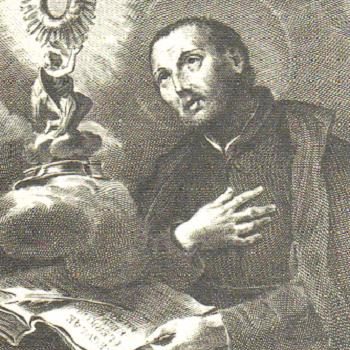
St. Francis CaraccioloFrancis was born on October 13, 1563, in Italy. At one point in his life he contracted leprosy, but after being miraculously cured, he vowed himself to the service of God. He gave away all his worldly goods and left for Naples in 1585 to study theology. After being ordained a priest in 1587, he […]
Read More

Heeding the Mary and Divine Mercy Connection

By Joseph Pronechen | This May 18 Pope Francis decreed that St. Faustina Kowalska’s feast day be added to the Roman Calendar as an optional memorial to be celebrated by all on Oct. 5.

There’s a great lesson here — more than…

Read More

What is Civilization?

By Joseph Pearce | Is civilization worth defending? Should we aim to conform to it so that we can be considered civilized? Should we aim to bring our children up according to its norms so that they can also be considered…

Read More

Why this Spokane Catholic school is going classical

Spokane, Wash., Jun 3, 2020 / 06:30 pm (CNA).- St. Charles Catholic School in Spokane, Washingon adds its name to a growing list of Catholic schools across the country that hope to find a renewal through an embrace of a classical liberal arts educational model.

St. Charles sits in a part of the Spokane metro area that is thick with Catholic schools. Four other parochial schools are within a ten minute drive from St. Charles. With so many Catholic schools in the area, the question for each school is, “what sets us apart?”

St. Charles’ decision to embrace a classical liberal arts model follows a track record of schools making the same transition. In Denver, Colorado, Our Lady of Lourdes School had only 104 students enrolled when it decided to switch to a classical curriculum. The following year, enrollment increased to 180 and the growth has continued. In the fall of 2018, Lourdes opened a second campus.

St. Charles’ move to classical was not a forgone conclusion; the school has had several changes of leadership over the last few years. In 2019, the school welcomed a new pastor and principal, Fr.  Esteban Soler and principal Heather Schlaich. As school leaders looked at the future of the school, they hoped to bring stability and growth to the school.  

Soler said he “has a heart” for classical liberal education and for the humanities. Growing up in Argentina, the priest was classically educated from 6th grade through high school. For Schlaich, the appeal of a classical liberal arts curriculum was multifaceted.

“In doing our research, we found it is an idea that is spreading nationwide,” she said. The emphasis on the arts also impressed Schlaich, whose background is music education.

“Knowing that we needed something new and exciting in our community, and knowing that there is a need to fill because there isn’t a Catholic elementary school that is classical in Spokane, we felt this is a niche we could fill,” she added.

The decision to fill a niche role with a classical curriculum is expected to help neighboring Catholic schools. Rather than competing for the same pool of students, St. Charles hopes to bring new families into the Catholic school system.

“I’m hoping we meet that need and get more kids into Catholic school,” Schlaich said.

For those who are not familiar with it, the idea of classical education can seem mysterious.  But Schlaich said there is a simple way to define the underlying principle of classical liberal arts education: “I would describe it as an integration of subjects with the faith.”

Explaining further, Soler stressed the unity of the curriculum, all subjects are rooted in faith and in the Catholic vision that all truth comes from God.

“The curriculum is oriented to help the kids to grow in a coherent base, where everything is understood as a whole, before they can go to different specifications.”

A classical education can seem old-fashioned to many, and in a way, it is. The roots of classical curriculum go right back to ancient Greece. The educational model continued to develop in Mediterranean and European countries. The curriculum is not stuck in the past though; technology is incorporated into the classroom on an as-needed basis and the curriculum meets current educational standards, school leaders told CNA.

What about Latin? The students at St. Charles will learn Latin, starting in kindergarten. The study of one or more of the classical languages, Greek or Latin, is a hallmark of classical schools. Soler will teach the students Latin himself, having an extensive background in Latin himself, studying the language for 10 years both in Argentina and in Rome.

Schlaich said that compared to a typical secular, modern school, the focus of a classical school is on “cultivating wisdom and virtue.” The school does this by “teaching the students Latin, exposing them to high quality literature, and focusing on appreciation of beauty, goodness, and truth.”

After the change was announced in the spring of 2020, those in the school community had many questions.  

“I have had a lot of positive feedback, [but] there is anxiety in some people, I would say, because it is a change, and there is anxiety with any change,” Soler noted.

Priest and principal met with families to explain the changes, and while many families are supportive, some have decided to move to neighboring schools.

Heather Morrisson, a parent of St. Charles’ students said she is excited for the change in curriculum. “I love that we are integrating religion into every aspect of the curriculum and I like that we are encouraging critical thinking in the students.”

Schlaich said the response from teachers has also been enthusiastic.

“Our teachers are very loyal,” she said. “They are excited we are going to be digging deeper, looking at deeper meanings.”

Soler said he is looking forward to the adventure of undertaking this change.

“We will be the only Catholic school in the area – not in the state because we have St. Monica on Mercer Island, and there are other schools in the Seattle area looking to make the change – but we will be the only one in the area to make the change.”

Looking to the future, both Soler and Schlaich are hopeful about the transition.

“We are excited,” Fr.  Soler said. “It is a challenge, but overall, I think it will be good. I think it will attract families who are not served by Catholic schools now. The school is part of the life of the parish. The mission of the parish, like every Catholic parish, is to evangelize. I hope the school will help bring the students to a deeper knowledge of Christ.”


Read More

Recent Comments

    Categories